
BIBLE STUDY
Genesis 4
Cain, Abel & The First Murder
Overview
Genesis 4 opens the door to a world forever changed by the Fall. Here we meet Cain and Abel — the first children born into a broken world — and witness the first act of worship, the first rejection, and the first murder. Yet even in this darkness, God is present, speaking, and extending mercy.
Genesis 4 (ESV)
1 Adam made love to his wife Eve, and she became pregnant and gave birth to Cain. She said, ‘With the help of the LORD I have brought forth a man.’ 2 Later she gave birth to his brother Abel. Now Abel kept flocks, and Cain worked the soil. 3 In the course of time Cain brought some of the fruits of the soil as an offering to the LORD. 4 And Abel also brought an offering—fat portions from some of the firstborn of his flock. The LORD looked with favor on Abel and his offering, 5 but on Cain and his offering he did not look with favor. So Cain was very angry, and his face was downcast. 6 Then the LORD said to Cain, ‘Why are you angry? Why is your face downcast? 7 If you do what is right, will you not be accepted? But if you do not do what is right, sin is crouching at the door; it desires to have you, but you must rule over it.’ 8 Now Cain said to his brother Abel, ‘Let’s go out to the field.’ While they were in the field, Cain attacked his brother Abel and killed him. 9 Then the LORD said to Cain, ‘Where is your brother Abel?’ ‘I don’t know,’ he replied. ‘Am I my brother’s keeper?’ 10 The LORD said, ‘What have you done? Listen! Your brother’s blood cries out to me from the ground. 11 Now you are under a curse and driven from the ground, which opened its mouth to receive your brother’s blood from your hand. 12 When you work the ground, it will no longer yield its crops for you. You will be a restless wanderer on the earth.’ 13 Cain said to the LORD, ‘My punishment is more than I can bear. 14 Today you are driving me from the land, and I will be hidden from your presence; I will be a restless wanderer on the earth, and whoever finds me will kill me.’ 15 But the LORD said to him, ‘Not so; anyone who kills Cain will suffer vengeance seven times over.’ Then the LORD put a mark on Cain so that no one who found him would kill him. 16 So Cain went out from the LORD’s presence and lived in the land of Nod, east of Eden. 17 Cain made love to his wife, and she became pregnant and gave birth to Enoch. Cain was then building a city, and he named it after his son Enoch. 18 To Enoch was born Irad, and Irad was the father of Mehujael, and Mehujael was the father of Methushael, and Methushael was the father of Lamech. 19 Lamech married two women, one named Adah and the other Zillah. 20 Adah gave birth to Jabal; he was the father of those who live in tents and raise livestock. 21 His brother’s name was Jubal; he was the father of all who play stringed instruments and pipes. 22 Zillah also had a son, Tubal-Cain, who forged all kinds of tools out of bronze and iron. Tubal-Cain’s sister was Naamah. 23 Lamech said to his wives, ‘Adah and Zillah, listen to me; wives of Lamech, hear my words. I have killed a man for wounding me, a young man for injuring me. 24 If Cain is avenged seven times, then Lamech seventy-seven times.’ 25 Adam made love to his wife again, and she gave birth to a son and named him Seth, saying, ‘God has granted me another child in place of Abel, since Cain killed him.’ 26 Seth also had a son, and he named him Enosh. At that time people began to call on the name of the LORD.
Deep Dive
Cain and Abel: Two Brothers, Two Offerings
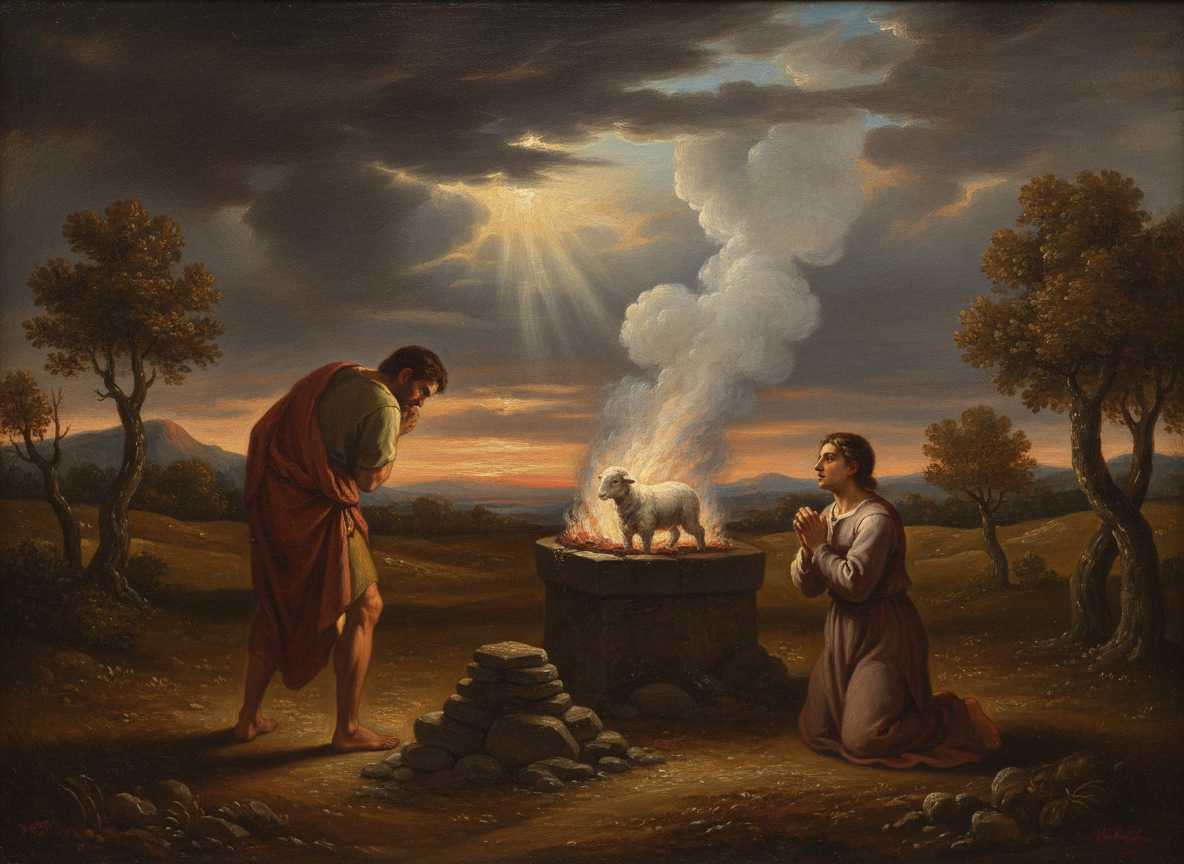
From the very first generation, humanity faced a choice: how to approach God. Cain, a farmer, brought ‘some of the fruits of the soil’ — a generic offering with no indication of firstfruits or sacrifice. Abel, a shepherd, brought ‘fat portions from some of the firstborn of his flock’ — the best, the first, offered with intentionality.
The contrast is not merely about what was brought, but how and from what posture of heart. Hebrews 11:4 tells us Abel offered his sacrifice ‘by faith’ — meaning his offering was rooted in trust and reverence toward God. The difference was not occupation, but orientation.
Why Was Cain’s Offering Rejected?
Theologians have long debated this question. Some point to the type of offering — blood vs. grain — but the Mosaic Law later allowed grain offerings, so type alone cannot be the answer. The deeper issue appears to be the condition of Cain’s heart. God’s response to Cain’s anger (v. 6–7) suggests God saw something in Cain’s inner posture before the offering was even made.
1 John 3:12 warns us not to ‘be like Cain, who belonged to the evil one and murdered his brother. And why did he murder him? Because his own actions were evil and his brother’s were righteous.’ The rejection was not arbitrary — it was revelatory. God saw what Cain was.
Sin Is Crouching at the Door
Before the murder, God gave Cain one of the most striking warnings in all of Scripture: ‘Sin is crouching at the door; it desires to have you, but you must rule over it’ (v. 7). Sin is personified here as a predator — patient, waiting, hungry. This is not sin as a mistake but sin as a force that seeks mastery over us.
God’s warning to Cain is also a word to every reader: you are not helpless. ‘You must rule over it’ implies agency and responsibility. Cain had every opportunity to turn back. Instead, he made a plan (‘Let’s go out to the field’) and carried it out. Sin, given an inch, took everything.
The Mark of Cain: Judgment or Mercy?
The mark God placed on Cain is often misunderstood. Scripture does not describe what it was — it may have been physical, symbolic, or spiritual. What it clearly was: protection. God declared that anyone who killed Cain would face sevenfold vengeance. The mark was not a brand of shame but a shield of life.
This is one of the most stunning displays of grace in Genesis. Cain murdered his brother. God could have ended him. Instead, God protected him. The God of Eden — who sought Adam and Eve after the Fall, who warned Cain before the murder — is the same God who marks a murderer for protection. Justice and mercy coexist in the character of God.
Two Lines: Cain’s Legacy vs. Seth’s Hope
The rest of Genesis 4 traces two family lines. Cain’s line builds cities, invents music and metalwork, and produces Lamech — who boasts of his own violence and escalates Cain’s vengeance to seventy-seven times. Cultural achievement without God becomes a monument to self.
Seth’s line ends the chapter quietly but profoundly: ‘At that time people began to call on the name of the LORD’ (v. 26). The seed of Eve — the promised line — runs through Seth, not Cain. In the darkest chapter, God is already writing the story of redemption.
Study Questions
- What did Cain and Abel each bring as an offering, and what do you think the difference signified?
- Why do you think God accepted Abel’s offering but not Cain’s? What does Hebrews 11:4 add to your understanding?
- What was God’s warning to Cain in verse 7, and what does “sin is crouching at the door” mean for your own life?
- How did Cain respond to God’s warning — and how do we sometimes respond the same way?
- What does Cain’s question “Am I my brother’s keeper?” reveal about his heart — and about ours?
- Why do you think God put a mark on Cain and protected him even after the murder?
- What does this chapter teach us about the nature of sin — how it grows when not addressed?
- How do you see both God’s justice and God’s mercy in this chapter?
- Where do you see the theme of “two paths” — obedience vs. rebellion — running through Genesis 4?
- How does Hebrews 12:24 (“Jesus speaks a better word than the blood of Abel”) change the way you read this chapter?
Key Themes
Worship & Sacrifice
True worship requires the right heart, not just the right ritual. God sees through the offering to the one who brings it.
Sin & Consequence
Sin unchecked grows — from anger, to planning, to murder. What we allow to crouch at our door will eventually come through it.
God’s Mercy
Even in judgment, God extends grace. The mark of Cain is also a mark of protection — justice and mercy held together.
Cross-References
- Hebrews 11:4 — Abel’s faith made his offering acceptable
- 1 John 3:12 — Do not be like Cain, who belonged to the evil one
- Jude 1:11 — Woe to those who have taken the way of Cain
- Matthew 23:35 — The blood of righteous Abel
- Romans 5:12–14 — Sin entered the world through one man
- Hebrews 12:24 — Jesus speaks a better word than Abel’s blood
A Note of Hope
Genesis 4 is one of the darkest chapters in human history — and yet God is on every page. He warned Cain before the murder. He sought him out after. He marked him for protection. He did not abandon a murderer. If God pursued Cain, He pursues us too. The blood of Abel cried out from the ground for justice — but Hebrews 12:24 tells us that Jesus speaks a better word than the blood of Abel. His blood does not cry out for justice. It cries out for mercy. The story is not over. It never was.
 Digging Deeper